


Can supermarket shelves talk? How VST won two awards at IIEX Europe 2026

We opened with a question that sounds like a riddle. Can supermarket shelves talk?
In 1877, Thomas Edison built the first machine that recorded sound and played it back. For the first time, a voice could be captured, stored, and asked to repeat itself. Retail shelves have been holding their own record all along. Every facing, every price change, every gap, every reset writes down what is happening in a category. The information has always been there. The problem has been getting the shelf to say it out loud.
The problem is scale, and it is messy
There are 3 million grocery stores across the globe. Each one runs hundreds of categories, and each category sits on a planogram that changes constantly. Pull that data together and it arrives in the worst possible shape: exported from different systems, formatted to different rules, and hard to line up against sales figures because the product codes and dates rarely match.
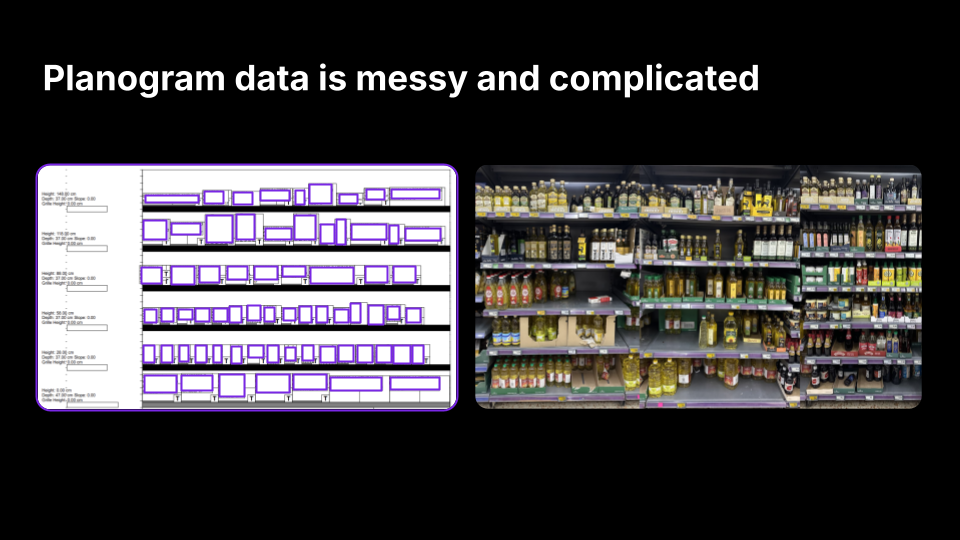
We showed the audience what category teams actually face. On one side, a planogram file rendered as a maze of measurements and bounding boxes. On the other, a photograph of a real fixture, shelves of oil and condiments, where the plan and the reality rarely match. Planogram data is messy and complicated, and that is before anyone tries to turn it into a decision.
The scale of the data behind VST
VST has processed billions of rows of shelf data since launch. If we laid out the shelf space we have received since launch, the shelves would reach the moon and back four times.
.png)
The architecture is straightforward to describe. Three sources flow in: retailer data from live shelf and sales feeds, brand data, and open source data such as weather and location. VST organises all of it into a standardised structure, with the right data tables, models, and security.From there, the products draw on the same foundation - Coplan for understanding where a category sits now against its past, Studio for building and sharing planograms with stakeholders, Testing for proving a category vision before committing to it, and Ask VST for conversational analytics.
Ask VST then allows users to expose that standardised data structure to AI. A category team can use Claude, ChatGPT, or Gemini, or whichever frontier data model of choice, and ask it questions in plain language. The shelf, finally, talks back
From four manual steps to one
The clearest way to show the value was to put the old workflow next to the new one.
Without VST, shelf intelligence travels through four manual steps and takes weeks. An analyst starts with raw data, moves it into a spreadsheet, exports an external Excel report, then builds a presentation, all to land a single insight such as a quarter's category growth.
.png)
With VST, the same insight takes one step and seconds. The standardised data sets feed LLM-generated reporting directly, and the answer comes back finished. We demonstrated it live, generating a chilled drinks reallocation playbook complete with shelf charts and a recommended action, from a single prompt. This is not roadmap AI. This is AI-ready.
This is the claim the pitch was built to prove: shelf intelligence that outperforms category analysts, every time. Like superpowers for your category teams.
Why it won
Two awards at the Insight Innovation Competition tell us two things. The Audience Favourite Award says the room recognised the workflow, because everyone who has wrestled a planogram export at 9pm knows exactly what days of manual work feels like. The Industry Impact Award says the judges saw where this goes: a data foundation deep enough that brands can connect their own AI and get category answers in seconds.
Thomas Edison gave sound a voice it could replay. VST gives the shelf one. After IIEX Europe 2026, a lot more of the industry has heard it.
Thank you to everyone who voted, and to Charlotte and Yasmine for taking the stage in Amsterdam.
Watch this space.
.jpg)
